Last updated: October 2026
To help you find the best bra for your beautifully imbalanced boobs we’ve pulled together some tips and suggestions from experts who understand breast asymmetry and how to measure for bras with uneven breast sizes.
Quick Jump
- Step 1: Measure your band size
- Step 2: Measure your bust/cup size
- Step 3: Calculate your bra size
- Step 4: Get the best fit
- Get professionally fitted
- Frequently asked questions

Measuring Tips For Bras With Uneven Breast Sizes
Here’s where we get to the bra measuring nitty gritty (or should we say, titty gritty)! We always suggest that you give yourself enough time to find the right bra fit. It can take a little trial and error to measure and find the perfect bra, especially when you have uneven breast sizes. It is a worthy quest though, as the benefits of wearing the correct bra size are vast! Set aside some time especially for this ‘breast quest’, be that at home or by booking an appointment at a lingerie shop. Don’t be disheartened if it takes a couple of sessions to find something that’s right for you and your boobs, it will be worth the effort. We’ve put together a step by step guide to help make finding a bra for your uneven boobs as simple as possible.

Step 1 - Measure your bra band size
The band of your bra gives around 80% of the support for your bosom (a bit of bra science there), so it needs to be right. Ideally it’s best to get someone to take your band measurement, but if you are measuring yourself, ensure the tape measure is snug to the base of your breasts and level across the back below the shoulder blades.
How to measure your band size:
- Place the end of the tape measure in your non-dominant hand on that same side of your body, and hold to the breast directly below your armpit (where the bottom of your bra band sits).
- Hold the tape measure firmly in place with your non-dominant hand. Then, use your dominant hand to bring the tape around your back and back across the front at the base of your breasts.
- Ensure the tape is flat to your skin and use your dominant hand to pull the measure tightly and snugly to meet the end in your other hand.
- Take a note of this measurement in inches. If your measurement is an even number in inches, this is your band size. If it is an odd number you can round up or down (if you have a lean build, round down; if you have a fuller, softer build, round up).
Top Tip: Remember that tape measures do not have as much ‘give’, so the band of a bra will be more forgiving when tried on. The most common bra fitting error is bra bands that are too loose, which significantly throws off the rest of the bra size.

Step 2 - Measure your bust/cup size
This is the juicy bit, as taking bust measurements can be a little different when measuring for a bra with uneven breasts. Whilst in reality ALL breasts have some level of difference, we are specifically talking about our beautifully imbalanced asymmetric bosoms here.
For slight asymmetry you may be able to use the traditional measurement method by passing the tape measure around the back and measuring across the fullest part of the bust (both breasts).
This doesn’t work so well for more prominent asymmetry, so instead we’re going to share with you how to measure the larger breast only.
Bra sizing is based on the assumption of breast symmetry (we know, it’s bonkers!) so if you have a difference of more than 1 cup size, it can help if you measure to allow enough space for the equivalent of two of your largest breast. This will ensure that your bigger breast is properly supported in the bra cup.
- Place the end of the tape measure in your non-dominant hand directly below your armpit, to the side of your breast. This time we will be measuring the larger breast only, rather than all around the bust.
- Bring the measure to the centre of your chest, between your breasts. Be careful not to squeeze the tape measure into the breast tissue, but rather gently rest on it.
- Note this measurement in inches, and then double it.
- Next, place the tape measure at the side of the breast again, and now bring it around your back to the side of your smaller breast under the armpit, taking a back measurement only.
- Finally, add these two figures together and this will be your bust measurement.

Step 3 - Calculate your overall (suggested) bra size
- Simply put, the bigger the difference between band and bust, the bigger the breast volume and therefore cup size.
- For every inch of difference, your cup size will go up a letter. The smallest difference starts with an A cup (or AA for less than an inch difference).
- A difference of 2 inches is a B cup, 3 inches is a C cup, and so on.
- Past a D cup, UK sizes run DD, E, F, FF, G, GG, H, HH, J, JJ and so on, although sizing varies internationally and between brands.
Use this table as a quick guide to UK cup sizes:
| Difference between bust and band | UK cup size |
|---|---|
| Less than 1 inch | AA |
| 1 inch | A |
| 2 inches | B |
| 3 inches | C |
| 4 inches | D |
| 5 inches | DD |
| 6 inches | E |
| 7 inches | F |
| 8 inches | FF |
| 9 inches | G |
| 10 inches | GG |
| 11 inches | H |
| 12 inches | HH |
Example: a 32 band size and a 36 bust size is a 4-inch difference, which would indicate a D cup: 32D.
Step 4 - Get the best bra fit for your breast asymmetry
Once you’ve determined your suggested bra size, think of this as your starting point. Measurements are only a guide.
- Wear your new bra on the loosest hook when you first get it, moving in as it loses elasticity.
- Make sure your band fits snugly: two fingers should fit under the band, but you shouldn’t be able to pull it more than an inch from your skin.
- Straps only provide about 10% of support. If your bra rides up at the back, this usually means the band is too big, not that the straps are too short.
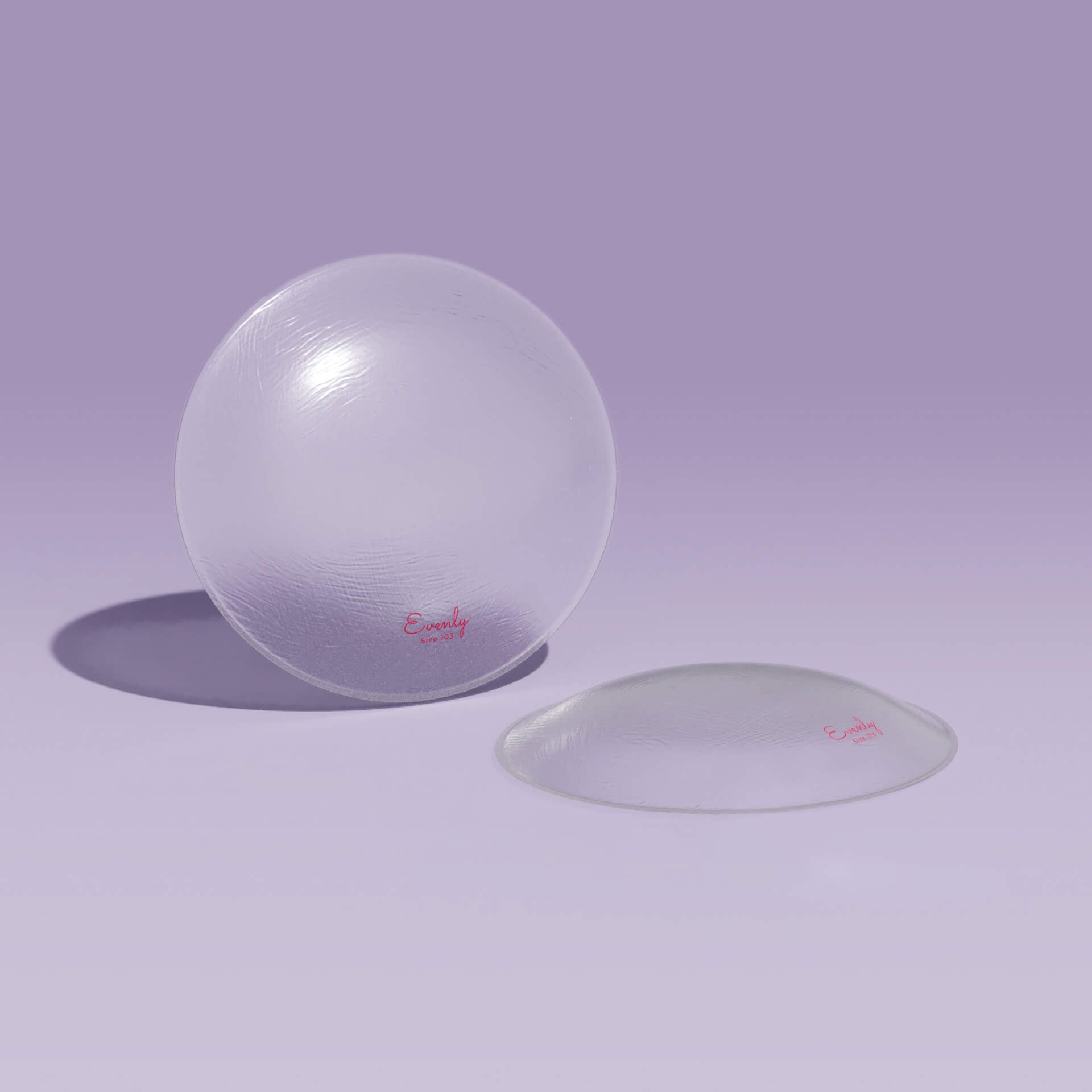
- Get Evenly. If you have a gap in the cup on your smaller side, slip in a Bra Balancer™ to even out the look and weight of both breasts.
Get Fitted By Someone Who Has Seen It All Before
One tried and tested option is to visit a professional bra fitter. Breast asymmetry is very common and your fitter will be more than familiar with it. As well as measuring you, a good fitter will talk you through different styles and shapes, what works for your lifestyle and wardrobe, and when to go up or down a size, since every brand fits slightly differently. For extra reassurance, choose from one of our Evenly-accredited fitters and stockists.
Try Different Bra Styles and Brands That Work For Your Breast Asymmetry
Bra fit and suitability varies with style, just like jeans. Allow extra time trying different styles and brands in your newly suggested size.
Understanding Sister Sizing For Bras
Sister sizes are bras that hold the same cup volume on a different band. Go down a band size and you go up a cup, go up a band size and you go down a cup. For example, the sister sizes of a 32D are a 30DD and a 34C. This is useful if the cups fit well but the band feels too loose or too tight.
Your Boobs Aren’t The Problem, Bras Are!
All bras are designed and made symmetrically, which none of our boobs are. If you can’t find your ‘glass slipper’ straight away, it’s not you that needs fixing, it’s the bra.
Frequently Asked Questions
What if my breasts are more than one cup size apart?
Measure and fit for your larger breast, then use a bra insert or Bra Balancer™ to fill the smaller cup. This works whether the difference is half a cup or several cup sizes, you’ll just need a thicker insert for a bigger gap.
Do I need to buy bras in two different sizes?
No. Bras are made symmetrically, so you fit to your larger breast, which gives you one band size and one cup size. A Bra Balancer™ then fills any gape on the smaller side.
What if my measurement falls between two sizes?
Round up if you have a fuller, softer build, or round down if you have a leaner build, then try both when trying bras on. Sister sizing (explained above) is also worth exploring.
Should I measure myself or get professionally fitted?
Either works. Self-measuring at home is a great starting point, but a professional fitting, ideally with an Evenly-accredited fitter, will usually get you to the right size faster, especially with more pronounced asymmetry.
How often should I re-measure?
Any time your bras stop fitting the way they used to, and always after pregnancy, breastfeeding, or a significant weight change, since asymmetry can shift during these times.